To recreate the sound of instruments
played in a concert hall, speakers should be designed as though
they were actual musical instruments. In particular, the speaker
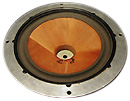
diaphragms ought to be made of wood — the same material used for making violins, cellos, and other instruments. This was the engineering dream that first got the ball rolling at JVC.
First
Prototype (Made of Fan-Shaped Wood Sheets Pasted Together)
There was, however, one significant
barrier to the development of a wooden diaphragm — stamping.
Wood easily cracks and can even break entirely when stamped. JVC
engineers tried all sorts of techniques to solve this problem,
including boiling the wood sheets and soaking them in water. Nothing
seemed to work.
Cracking
Curling
A Surprising Solution
Dried Squid
(VERY CHEWY!)
Japanese Rice Wine
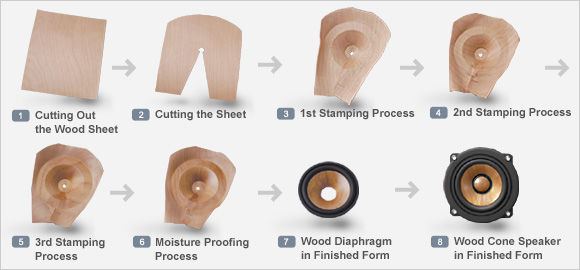
Many years into the search for an answer to the stamping problem, a solution was finally hit upon. It happened that one of JVC's engineers visited a Japanese pub after work, and he was regularly served a dish of soft squid (a fairly common snack in such pubs). How, he wondered, was this typically hard and rather rubbery food softened? A little research led him to discover that squid is softened when it is soaked in sake, or Japanese rice wine, overnight. Putting two and two together, the engineer and his fellow researchers soon discovered that sake could do the same thing for wood — when soaked in sake, a wood sheet becomes soft and pliable enough to undergo the stamping process without breaking or cracking.
Extensive testing yielded another discovery — birch, and particularly
the densest, firmest part of the core, offered the optimum set
of acoustic characteristics. The utmost care is taken to manage
temperature and pressure during repeated stamping processes, and
the use of special thermosetting resin allows the wood diaphragm
to retain its shape over time, thus completing the intricate wood
cone production process.
Wood Cone Speaker Production Process
Optimising the Wood Cone Sound
To fully exploit the wooden diaphragm's superior acoustic characteristics,
JVC paid rigorous attention to every detail of the compact component
system. The speaker system is carefully finished with a range of
high-grade components and comes with a real cherrywood enclosure.
Superior speaker driveability and high-fidelity sound are ensured
by the JVC-exclusive Hybrid Feedback Digital Amplifier. The centre
unit also features special internal construction and carefully
selected premium parts and devices, which contribute to the system's
astounding sound quality.
Collaboration with Sound-Creating Professionals
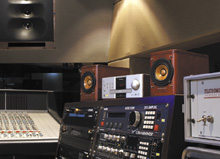
JVC collaborated with studio engineers from the Tokyo
Aoyama Recording Studio, a JVC affiliate, in the final sound-tuning
stage of EX-series systems. The joint effort was aimed at
achieving JVC's ultimate goal in developing the units — sound
reproduction that comes as close as possible to what musicians
and composers originally intended.
The studio engineers also provided valuable input regarding
the selection of parts and materials for the centre unit,
and the most appropriate layout.
Tokyo Aoyama Recording
Studio
This history-making JVC innovation will give you
a virtual front-row orchestra seat, with the musicians performing
right in front of you — so close you can almost see the movements
of their fingers
The World's First Wood Cone Speaker Compact System — The EX-A1