
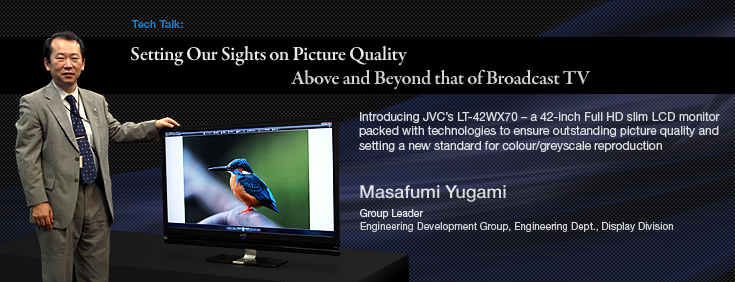
The LT-42WX70 is the first of the new JVC XIVIEW series, representing an innovative concept in displays – created not for TV viewing but rather as monitors in which the emphasis is on high-quality photography as well as styling that blends with modern interiors. We interviewed Masafumi Yugami, Group Leader in charge of development, in order to obtain a behind-the-scenes perspective on the development process.
What was it that led you to develop this product in the first place?

Right now, we are seeing the widespread adoption of digital broadcasting, and Full HD has become the mainstream for television displays. This makes the task of making further improvements in picture quality, performance and functions, no easy challenge. If we consider what one might call the current status of high-picture-quality displays, there is a feeling that, for the general consumer anyway, picture quality has been improved by about as much as it ever will be. And industry talk of a “passion for picture quality” and so on no longer has the same impact. Nevertheless, there are indeed fields in which picture quality continues to make further strides. Amongst us there was this motivation, a desire to create a product packed with technologies to ensure really high picture quality that could meet the requirements of people who were not satisfied with current HD displays, customers seeking outstanding picture quality, above and beyond that of today’s HD broadcasting.
If we were to realize this goal, we felt that the key must lie in making high picture quality easy to understand. So we delved into the question of what exactly is this user segment seeking even higher picture quality. And we arrived at the conclusion that it consists of photographers adept at using HD digital SLR cameras, and also home theatre enthusiasts. Particularly, in the digital camera market – where the drive towards higher picture quality is undiminished – there has been conspicuous growth in sales of SLRs. Last year alone, almost 10 million SLR cameras were shipped globally, representing about 10% of all digital cameras. Naturally, this is the segment that we believe demonstrates potential demand for display devices offering higher picture quality. So, what inevitably triggered development of this product was the idea that we should set our sights for picture quality above that of conventional broadcasting – that is, to the level of still photographs that transcend HDTV, which is for us the key point. This meant harnessing the technologies necessary to achieve that sort of level of picture quality.
How does the development of a photographic monitor differ from that of a TV?
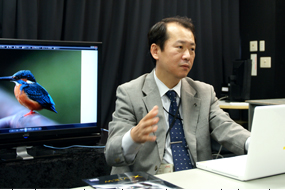
When it comes to panels intended for watching TV images, what is referred to as "picture refinement" is an essential part of the display engineer's job. For the average viewer, there's a tendency to feel that, rather than a straightforward, unvarnished display of images that were specifically created for broadcasting, it's preferable to watch a display that can offer a certain amount of correction, or compensation. That's why picture refinement is so important for designing a display intended for TV viewing.
I think it's very natural to wonder why it should be at all necessary to make any adjustments to what is essentially a finished product. But a viewer watching something on TV has typically never been to the location where the video footage was actually shot, and so cannot know what it really looked like. This is a bit simplistic, but basically if you wanted to make a television that got higher marks you had to embellish the picture (make it look more vivid, for example) in a way that the average consumer would prefer, even if it meant deviating a little from the original. However, if instead you choose to make a still photograph monitor for users of digital SLR cameras, it's necessary to completely change your approach, switching from the conventional concept of "picture refinement" to "faithful colour reproduction". This is because looking at photographs is completely different to viewing broadcast content: much of the time the person viewing a photograph is the very person who shot it in the first place, so what is really wanted is a reference monitor for creating images that photographers themselves are satisfied with.
So our aim was to faithfully display the original scene, the original picture seen by photographers, complete with the colours they intended to capture. That's how we embarked on development of this high picture quality photographic monitor with faithful colour reproduction as our key concept.
Given that you were concentrating on faithful colour reproduction for photographic images, wasn’t there any impact on video images?
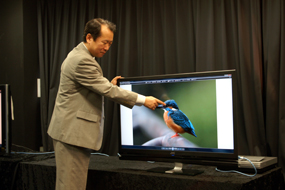
At the outset, we went ahead with development guided by this concept of ensuring faithful colour reproduction of the original picture, as I have explained. But what we discovered along the way was that it became possible to express in a very genuine way – and for video content too – subtleties that could not be rendered exactly as one would want with the conventional picture refinement used for video material.
For example, employing picture refinement if you made a slight change to the flesh tones, this had repercussions and other colours might no longer look natural. So for consistency it was necessary to make further changes and fiddle about with those other colours. But with our focus on faithful colour reproduction, we were able to achieve authentic, well-balanced images simply by treating as independent each element of colour reproduction and picture quality, and by processing them separately. This is what you might call the synergistic result of combining the high colour gamut and gamma correction technologies that we had newly adopted to achieve photographic picture quality, with the New DynaPix HD Picture Engine that we had previously developed for video content. One can say that because we had chosen as our standard the difficult goal of faithful colour reproduction for still photographic images, this had in fact beneficial effects all round; video content also benefits.
Specifically what sort of technological advances have been made?
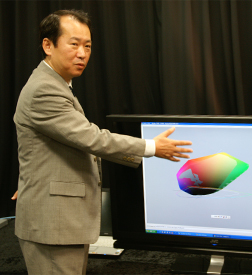
There are basically 3 main points as regards what we did to achieve such high photographic quality.
First, we developed the panel itself in-house. In recent years, the industry has focused on the width of the colour gamut of LCD panels. It’s certainly true that for faithful colour reproduction a panel must have a wide gamut; however, being wide is not in itself enough. For example, with a conventional panel that simply had a wide gamut, when it came to displaying video content with a narrower gamut than that of the panel, it was effectively stretched to match the panel gamut, and this led to distortion in which colours could be shifted considerably. Additional processing was therefore necessary in order to return these shifted colours to their original values. This inevitably led to fiddling with the picture in all sorts of ways. In order to overcome this, the characteristics of the LCD panel were very important, just as with the picture engine. This time, through in-house design of the LCD panel backlighting and the chromaticity points, we succeeded in ensuring that colour distortion does not arise.
Second, as part of the production process we calibrate each individual unit for RGB gamma (separately) and white balance using JVC’s own algorithms. This makes possible smooth greyscale gradations with no colour bias, while at the same time avoiding discrepancies from unit to unit, something that is unavoidable when manufacturing conventional LCDs for consumer use.
Third, using the latest firmware for the New DynaPix HD Picture Engine, colour signal conversion is applied so that the panel colour gamut matches the standard of the input signal, whether it is sRGB or Adobe RGB. In designing the circuit we made sure to prevent signal loss so as to ensure faithful colour reproduction for different sources with different gamut.
Please give us an example of the sort of problems you had to struggle with in developing this new genre of TV.
Actually, there were many, but if I had to choose one something that we paid more attention to than with a regular TV was probably the gamma and white balance calibration for each individual unit. With a conventional consumer TV, even if there are differences in gamma and white balance between one unit and the next, it’s not a big problem. But a photographer or video enthusiast who takes picture quality very seriously is not prepared to compromise on this. With the LT-42WX70, as part of the production process in the factory we measure the characteristics of each individual LCD panel and then we calibrate it to ensure the optimum gamma values and white balance tracking for that particular panel. For this we use JVC’s original calibration algorithms that are based on an accumulation of technological expertise in video-related engineering. Thanks to this, we have not just eliminated discrepancies, but we have also managed to achieve dramatic improvements in picture quality as a whole and tracking performance.
How do you go about treating still photographs and video content separately?
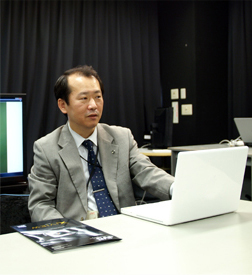
In developing this product, we were at first aiming to see how beautifully we could display photographic images. However, as obvious as it sounds, what photographers are looking for and what home theatre enthusiasts are looking for are two completely different things. So if you try to please both, neither is going to be satisfied with what they see. And the reason for this is that the picture quality we look for in a display varies greatly depending on the type of content and the viewing environment. In order to properly display both still and video images in a way that would satisfy all users, we designed the LT-42WX70 with extra latitude, offering presets on the one hand, and fine-tuning choices on the other.
First of all, we provided the product with preset modes that adjust picture quality to suit the type of content and viewing environment. These presets are Photo Pro mode for photographic picture quality, Standard and Dynamic modes for general TV viewing in a bright environment, Theatre mode for watching films with a home theatre setup, Game mode offering the rapid response required for video gaming, and PC mode for using the product as a computer monitor.
Could you tell us about these presets in a little more detail?

OK. Let me start with photographs.
For the faithful reproduction of still photographs we have Photo Pro mode.
Photo Pro mode offers compatibility with the sRGB and Adobe RGB standards used for digital photography. Also, in seeking to optimize faithful reproduction, we paid a great deal of attention to the three axes that determine this – namely, gamma, white balance, and colour. With today’s digital cameras, photographs of 10 megapixels or more are no longer special, so when displaying these on a monitor inevitably resolution is reduced to that of Full HD. Because of this, when using a conventional PC monitor the image tends to lack fine detail and sharpness. But with the LT-42WX70, in order to compensate for this physical limitation, we minutely calibrated sharpness and other parameters to create a sense of fine detail and definition that approaches the original image.
Monitor mode leans towards neither photos nor video images – that is, picture quality is not adjusted. As you would expect, this allows the product to be used as a computer monitor for displaying both still and video images using just the original signal.
Now I’ll move on to discuss the video modes.
People who mainly view regular TV programmes prefer to have more contrast. For them, Dynamic and Standard modes ensure stable picture quality whatever kind of signal is being transmitted. This is achieved by continuous compensation optimised for each individual image. This picture quality adjustment is based on JVC’s original algorithms and results in a balanced picture that is easy to view, minimizing eye strain even after several hours of viewing.
Theatre mode is for those people who prefer a home theatre experience. In order to convey what was the director’s intention in making a film, such as the atmosphere and ambience, it is necessary reproduce picture quality suited to its characteristics. Making use of its extensive experience with televisions equipped with LCD panels, JVC calibrates picture quality so as to convey the true flavour of a cinematic work. This optimization makes possible the display of images that are really true to the source.
Finally, to satisfy game enthusiasts who want to enjoy virtual reality worlds there is the Game mode. Normally, picture enhancements such as noise reduction effectively delay the monitor’s response speed. Gamers do not appreciate this because game software is usually free of noise anyway. So what we have done is to enable gamers to choose a process that skips three steps in picture quality correction. Thanks to this, response is even faster than with any JVC television to date. It’s something that will also satisfy gamers who attach importance to the picture and control response being synchronized.
So these 5 presets work some kind of magic?
No, the presets are nothing more than settings that we recommend. They are not intended to be the perfect solution. They are provided simply so that the user can start by trying them out. Earlier I said that we designed the LT-42WX70 with extra latitude, offering presets on the one hand, and fine-tuning choices on the other. And in order that the LT-42WX70 user can adjust picture quality to satisfy his tastes and aims, we have taken the vast number of parameters used by professional engineers for fine adjustment of LCD picture quality and assembled them into 52 modes that are made available through picture quality menus.
First, you should evaluate preset performance, and then if you want you can fine-tune the picture quality. If you like the result, you can then register those settings in memory. Next time around, you can call up those settings or even create new settings.
By thus enabling the user to enjoy the professional privileges of fine-tuning picture quality for both photographs and video content, we feel confident that the LT-42WX70 will satisfy any user who is looking for the highest levels of picture quality.
Finally, do you have any message for the many future users of this product?
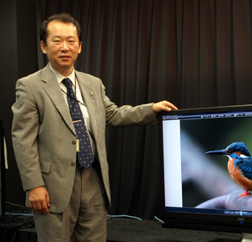
In developing the LT-42WX70 we were aiming at faithful colour reproduction. I hope that many customers will use the opportunity it offers to recall and relive, on a large screen, the thrill they received from the colours they captured with their camera. I also hope that they will enjoy being able to fine-tune picture quality to suit their own preferences.
Also, I’d like to add that this year the LT-42WX70 won the Best Photo Display award from Europe’s prestigious TIPA (Technical Image Press Association), an organization made up of major photo/video magazine editors from 12 European countries. This accolade is, I believe, proof that our aims and approach were both spot on.
